Eye of the Bee-holder A bee beauty pageant card game for 2-5 players
Eye of the Bee-holder
A bee beauty pageant card game for 2–5 players | 30 minutes
In the bee world, beauty is in the eye of the bee-holder! Compete to present the most desirable bees according to the Queen's ever-changing standards. Draft the criteria, play your best bees, and manipulate what the hive considers beautiful.
Components
- 64 Bee Cards — each with a unique combination of 6 attributes
- 6 Double-Sided Facet Tiles — one per attribute, showing the Queen's current preference
- 1 Queen's Favor Tile — determines first player and breaks ties
Bee Attributes
Each bee card has 6 binary attributes. A bee has one trait or the other:
| Attribute | ||
|---|---|---|
| Texture | Fuzzy | Shiny |
| Antennae | Feathered | Whips |
| Weapon | Stinger | Mandibles |
| Pattern | Striped | Solid |
| Wings | Sleek | Flutter |
| Payload | Honey | Pollen |
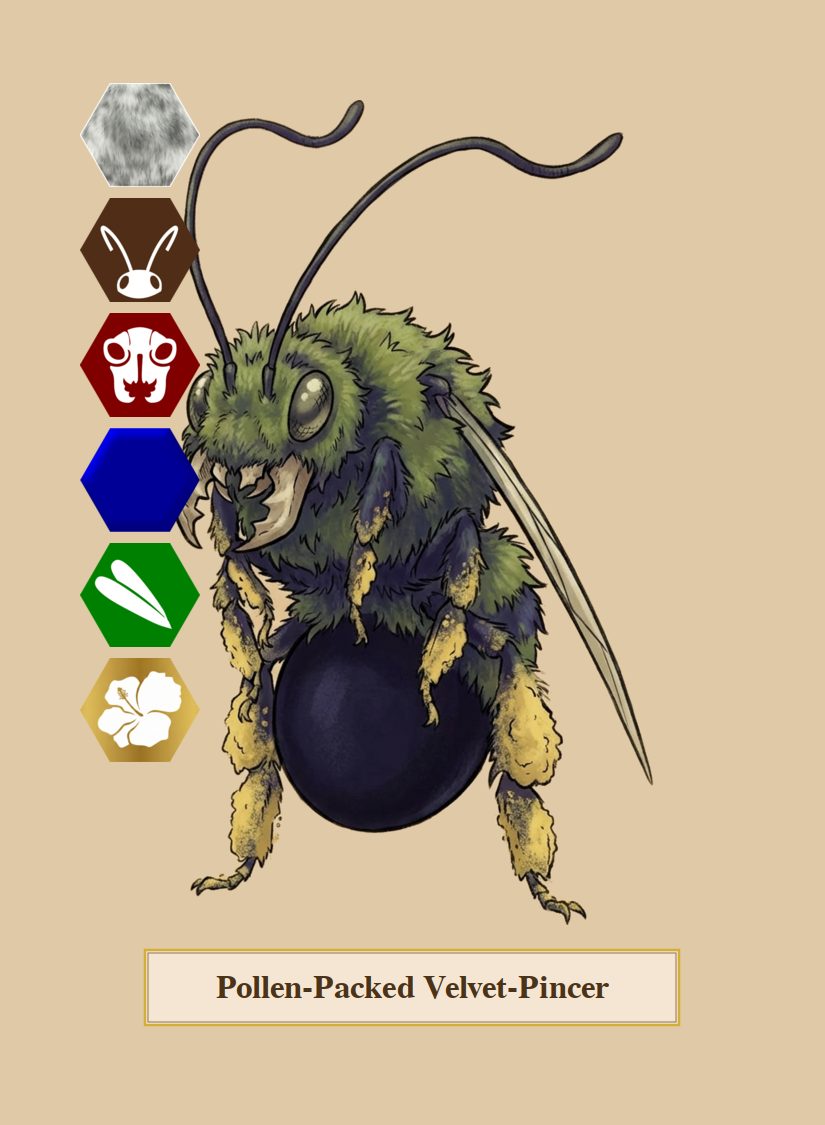
Every possible combination of these 6 attributes appears on exactly one card, giving 64 unique bees. Each card shows the bee's name, illustration, and its six attribute icons along the left edge.
Facet Tiles
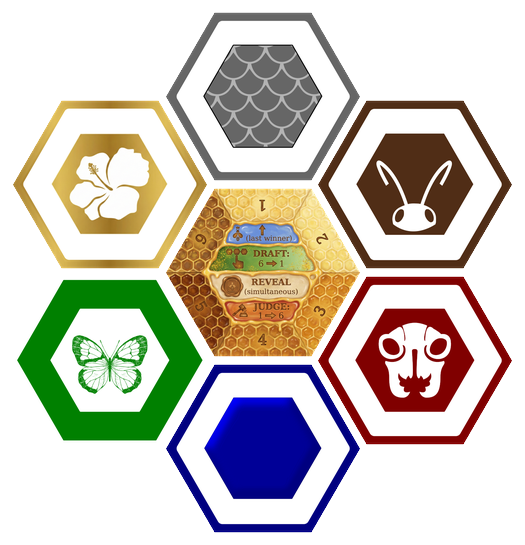
Each facet tile is double-sided, corresponding to one attribute — one trait per side. The face-up side shows which value the Queen currently desires for that attribute.
During the game, facet tiles are arranged in a circle around the Queen's Favor tile. Position matters: the tile nearest the player the Queen's Favor points to is Slot 1 (most important), and slots are numbered clockwise from there through Slot 6 (least important).
Setup
- Place the 6 facet tiles in the center of the table.
- Place the Queen's Favor in the center of the table, pointing to a random player.
- Shuffle all 64 bee cards and deal 7 cards to each player. Set remaining cards aside. Players look at their hands but keep them secret.
- Draft the Queen's Favor (see below).
Overview
The game is played over a series of hands, each consisting of 7 rounds (one per card in hand). Each round has three phases:
- Present — All players simultaneously play a bee card face-down, then reveal.
- Judge — The played bees are compared against the facet tiles to determine a winner.
- Manipulate — Each player takes one action to alter the facet tiles.
After all 7 rounds, check for a winner. If no one has won yet, deal a new hand and continue.
Drafting the Queen's Favor
At the start of each hand, players draft the 6 facet tiles into specific positions around the Queen's Favor tile. Drafting determines which attributes occupy each slot and which side is face-up.
The player that the Queen's Favor tile is pointing towards will draft last. Proceeding counter-clockwise from them, players take turns choosing from among the remaining attribute tiles, choosing one side to be face-up, and adding them around the Queen's Favor tile in the slots near them.
Drafting by Player Count
| Players | Drafting Order |
|---|---|
| 2 | Players alternate picking from Slot 6 down to Slot 1. First player drafts Slots 6, 4, 2. Other player drafts Slots 5, 3, 1. |
| 3 | First player drafts Slots 6, 5. Next player drafts Slots 4, 3. Last player drafts Slots 2, 1. |
| 4 | First player drafts Slots 6, 5. Next drafts Slots 4, 3. Next drafts Slot 2. Last drafts Slot 1. |
| 5 | First player drafts Slots 6, 5. Remaining players each draft 1 slot (4, 3, 2, 1) in counter-clockwise order. |
Playing a Round
Phase 1: Present
All players simultaneously choose one bee card from their hand and place it face-down in front of them. Once everyone has chosen, flip all cards face-up.
Phase 2: Judge
Compare the played bees against the facet tiles, starting from Slot 1:
- Check Slot 1. Does the played bee match the desired attribute value on this tile?
- If some bees match and others don't: eliminate all non-matching bees.
- If no bees match: skip this slot (all bees survive).
- If one bee remains: that bee wins. Stop judging.
- Repeat for Slot 2, then Slot 3, and so on through Slot 6. This will always result in a single winning bee.
The winning player scores 1 point for the round.
Phase 3: Manipulate
Starting with the player that won this round and proceeding clockwise, each player takes one action, either:
- Flip one facet tile to its opposite side, OR
- Swap the positions of any two facet tiles around the Queen's Favor.
Restriction: You cannot repeat the exact action taken by the player immediately before you. (You may perform the same type of action on different tiles.)
After all players have taken an action, the round is over. Begin the next round with Phase 1.
Note: The Manipulate phase is skipped after the final round (round 7) of each hand, since the facet tiles will be re-drafted for the next hand.
Winning the Game
After completing a hand (all 7 rounds), count each player's total score pile. The first player to reach 10 points wins.
- If one player has 10 or more points and leads outright: that player wins!
- If multiple players are tied at 10 or more points: enter Sudden Death.
- If no player has 10 points yet: deal a new hand and continue.
Sudden Death
Shuffle all cards, deal a new hand of 7, and draft the Queen's Favor as normal. Play rounds one at a time. After each round's Judge phase, check: does any single player now lead outright? If so, that player wins immediately. Otherwise, proceed to Manipulation as normal. If players remain tied at the top, keep playing.
Between Hands
When a hand ends without a winner:
- The player with the most points starts with the Queen's Favor (rotate the tile to point to them).
- Shuffle all 64 cards together, deal 7 to each player, and set the rest aside.
- Draft the attribute tiles around the Queen's Favor again.
Quick Reference
Round structure: Present (simultaneous) → Judge (Slot 1 through 6) → Manipulate (flip or swap)
Judging priority: Slot 1 > Slot 2 > Slot 3 > Slot 4 > Slot 5 > Slot 6
Manipulation actions: Flip 1 tile OR swap 2 tiles. Cannot repeat the previous player's exact action.
Win condition: First to 10 points with a clear lead.
Strategy Tips
- During the draft: Place your strongest attributes in the slots you control. Remember, Slot 1 dominates — if your best card matches Slot 1, it beats cards that match Slots 2–6 but miss Slot 1.
- When presenting: Play the card that survives the most filters. A card matching Slots 1 and 2 will beat a card matching Slots 3, 4, 5, and 6.
- Manipulation is key: A well-timed flip or swap before the next round can transform a weak hand into a winning one. Think about which changes help your remaining cards while hurting opponents.
- Watch the endgame: As players approach 10 points, sudden death tension rises. Controlling Slot 1 through manipulation becomes critical.
- Drafting trade-offs: By drafting first it may feel like you're just choosing tiebreakers, but you're choosing which tiles will not be eligible to be in the first few spots.